
Authors: Liz Mason-Deese, Craig Dalton, Nathan Swanson, Tim Stallmann, Maribel Casas-Cortes, Sebastian Cobarrubias Authors Map: Counter Cartographies Collective Website: countercartographies.org
An atlas of countercartography
As a collective with diverse ties to the university factory – adjuncts, fellows, freelancers, indebted graduate students, assistant professors under review, unemployed PhDs and caregivers – how do we situate ourselves in relation to increasingly undemocratic and exploitative infrastructures of higher education? How can we confront everyday precarity1 due to lack of access to housing, knowledge, healthcare, mobility, and employment? How can we organize to produce alternatives and reclaim life within and beyond the university?
As the Counter Cartographies Collective (3Cs), we map. Beginning with our own situations, we create a mapping of and for political change, combining militant research with counter-mapping to produce alternative ways of visualizing and inhabiting our university and world. Our mapping is grounded in the tradition of autonomous politics: emphasizing the power and creativity of labor over that of capital, realizing the need to go beyond state-centered activism and work for political change from below, and recognizing the centrality of struggles around knowledge production in the current political-economic context. As militant research, autonomous mapping simultaneously produces analyses and political interventions, helping us to understand and challenge the changing spaces of oppression where production/reproduction are geographically diffuse.
We use autonomous cartography to analyze and intervene in processes at the University of North Carolina at Chapel Hill and, through collaboration, at other institutions around the world. This mapping prompts critical and reflexive self-organizing cognizant of the many forms of labor at the university and the university’s role in the broader economy and social fabric. 3Cs’ autonomous cartography creates non-hierarchical relationships within our collective as well as open identities and unexpected alliances as people interact with our maps and begin to enact their university in new ways.
3Cs first formed not with a set mission or clear goals, but as an affinity group with common interests and methodological commitments. We were frustrated by talk among activist scholars on campus limited to their own field research sites. Much of this work attempts to contest divisions between academia and activism, yet reinforces the divide by geographically separating intellectual production within the university from activism outside. We wanted to do something politically and intellectually relevant to all of us instead. An opportunity arose when our university administration selectively canceled the Labor Day holiday, giving the administration the day off, but not students, educators or researchers. How to protest? Where to protest? Was this a labor protest? How could we, through understanding this situation, begin to enact a different university?
For us, these questions resonated closely with those of Precarias a la Deriva (Precarious Women Adrift), a self-identified militant research project based in Madrid, who developed geographic interventions using feminist drifts and picket-surveys. When major labor unions in Spain called a general strike in 2002, several women realized they were not in a position to participate. How could temp workers, the self-employed, workers on per-hour con-
tracts, and domestic workers strike? Who would even notice? To address these questions, Precarias developed a technique of feminist drifting. The drifts visited sites of precarious labor where workers were unable to participate in the general strike and asked a provocative question: What is your strike? Or what does it mean to go on strike in your situation? (Precarias a la Deriva, 2006). Asking this question served multiple purposes. Firstly, it stopped the production process for a few minutes: a mini-strike. Secondly, it investigated the conditions of work/life in the contemporary economy. Thirdly, it established connections among a disparate group of workers for future organizing.
In each drift, a different precaria would lead the group of drifters through their everyday trajectory, discussing their lives and answering questions along the way. As opposed to the Situationists’ use of the derivation to understand the literal structure of the city, the Precarias’ drift is a directed itinerary through the specific conditions of their personal everyday lives. Drifting was useful for exploring the spatial practices of precarious workers, who are often not confined to a singular or stationary workplace, allowing them to find intersection points between distinct and atomized itineraries in urban space, pointing to hierarchies and differences, as well as commonalities among different forms of labor.
Inspired by Precarias a la Deriva’s query, “what is your strike?”, we began our own drift on Labor Day. We set up at the social hub of campus with chalkboards, signs, paper and recording devices. We asked passers-by to talk about their own work by drawing maps and participating in interviews. We drifted through campus, visiting working classrooms and closed-for-the-holiday offices, mapping where work was or was not taking place.
The drift proved useful in its dual nature as research and spatial intervention. It provoked multiple reactions: confusing reporters as to whether it was “research” or a “protest”, and encouraging students and faculty to reflect on their own labor. It was a way to explore spaces and inhabit them differently. While our suburban college town is very different from Madrid, we found many similarities with the precarias’ experiences. Many people we talked to worked on temporary contracts with little job security, some worked multiple jobs or part-time with no fixed hours and low pay. As our research continued, we found an expensive and growing administration separated from the concerns of university workers. We found a push for privately funded research in competition for prestige. We found infrastructure designed to blur the lines between work and leisure to spark “entrepreneurship”, a specific subjectivity of the knowledge worker (Holmes, 2007).
We began to understand how our own daily activities in the university – our research, writing, volunteering, learning, and teaching – were work, productive labor enmeshed in the relationships of surplus and management of post-Fordist capitalism. Using concepts such as the social factory and general intellect, we were able to recognize the role of collective social knowledge in production and how that production occurs throughout the social field, involving diverse forms of labor. Theorists of cognitive capitalism, the commercialization of general intellect, recognize the university as a key site of value production and class struggle (Edu-Factory Collective, 2008), since immaterial, affective, and intellectual labor are increasingly important for producing value in the post-Fordist system (Lazzarato, 1996; Hardt & Negri, 2000). Even student leisure time can produce value within the social factory of the university by adding to the university brand (Bousquet, 2008). These open definitions of labor allowed us to recenter our understanding of how the university works based on women’s unpaid domestic labor, the production of culture and language we all participate in, and work that explicitly produces knowledge. However, the lack of a common space for immaterial labor makes it difficult for these workers to organize. Our solution, counter-mapping, is a pragmatic response in that it can identify the sites (physical, cultural and social) where immaterial labor takes place and create a common space of encounter, bringing people together to share experiences and analyses, generating alternative ways of being and acting in the university.
Counter-mapping springs from arguments in geography that emphasize the situated, productive role of power in mapping and related geographic knowledge production (Wood, 2010; Crampton, 2010). Emphasizing the productivity of power opens a multiplicity of cartographic power-knowledges and subject positions outside traditional institutional cartography – examples include public participatory GIS, art maps, and counter-mapping. Nancy Peluso coined the term “counter-mapping” to geography journals to describe mapping indigenous land claims (1995). But others, such as the Surrealists, the Situationists, Bunge’s geographical expeditions, responses to the plight of migrants to Europe, and recent conservation efforts all employ forms of counter-mapping (Wood, 2010; Bunge, 1971; Harris & Hazen, 2005; Holmes, 2003; Cobarrubias, 2009; Cobarrubias & Pickles, 2008).
Doing counter-mapping means navigating a set of weighty questions: How do we build conversations and solidarity through mapping, not authoritative cartographers and maps? What can be shown and what should remain obscured? How do we avoid co-optation by capitalist, state or colonialist discourses? 3Cs’ approach to these questions employs practices and theories of autonomous politics and militant research to engage in counter-mapping from our own situations.
We call this approach autonomous cartography. It builds on the insights of counter-mapping by using practices of militant research and ideas of autonomous politics. Pickles calls on mappers to engage in many different kinds of mapping to create new alternative spaces and worlds, “and, and, and” (Deleuze & Guattari, 1987; Pickles, 2003; Holmes, 2003; Cobarrubias, 2009). 3Cs’ practice intends to create new (political-geographic) possibilities and other (political-geographic) realities rather than (re)presenting existing geographies, drawing on Deleuze’s (1988) critique of representation and developing our own form of militant research2, inspired by Precarias a la Deriva and Colectivo Situaciones.
Militant research – research that produces knowledge for social struggle and is itself a form of political intervention – has multiple, situated approaches. Our first engagement with the term comes from the Buenos Aires-based Colectivo Situaciones. Eschewing objectivity and/or critical distance, their multiple re-
216 Counter-Cartographies Create Visibility
search initiatives attempt to break down the subject-object divide, describing the relationship between the researcher and researched as one of love or friendship. Both parties actively participate in this relationship and are transformed in the process (Colectivo Situaciones & MTD de Solano, 2002). Knowledge production affects and modifies the bodies and subjectivities of the participants and is an essential part of any political practice. Situaciones collaborates with social movements in conducting collective investigations as a form of political struggle, recognizing that “collective thought generates common practice” (Malo, 2007: 35). Not only is Colectivo Situaciones’ militant research an alternative to traditional academic research, it is also different from conventional forms of activism. It is a manner of doing politics that takes nothing for granted and leaves no room for the easy answers of dogmatic ideologies or party lines. It emphasizes the situatedness of any political struggle, making universal, pre-known answers impossible and calling for continual investigation and questioning (Colectivo Situaciones, 2007).
3Cs’ combination of counter-mapping with militant research renders autonomous cartography quite productive and evocative.
We do not disallow or discount other forms of mapping or militant research. Instead, we apply the proliferating logic of “and, and, and” to disseminate and acknowledge multiple new ways of mapping, producing cartographies explicitly in the grammar of struggle.
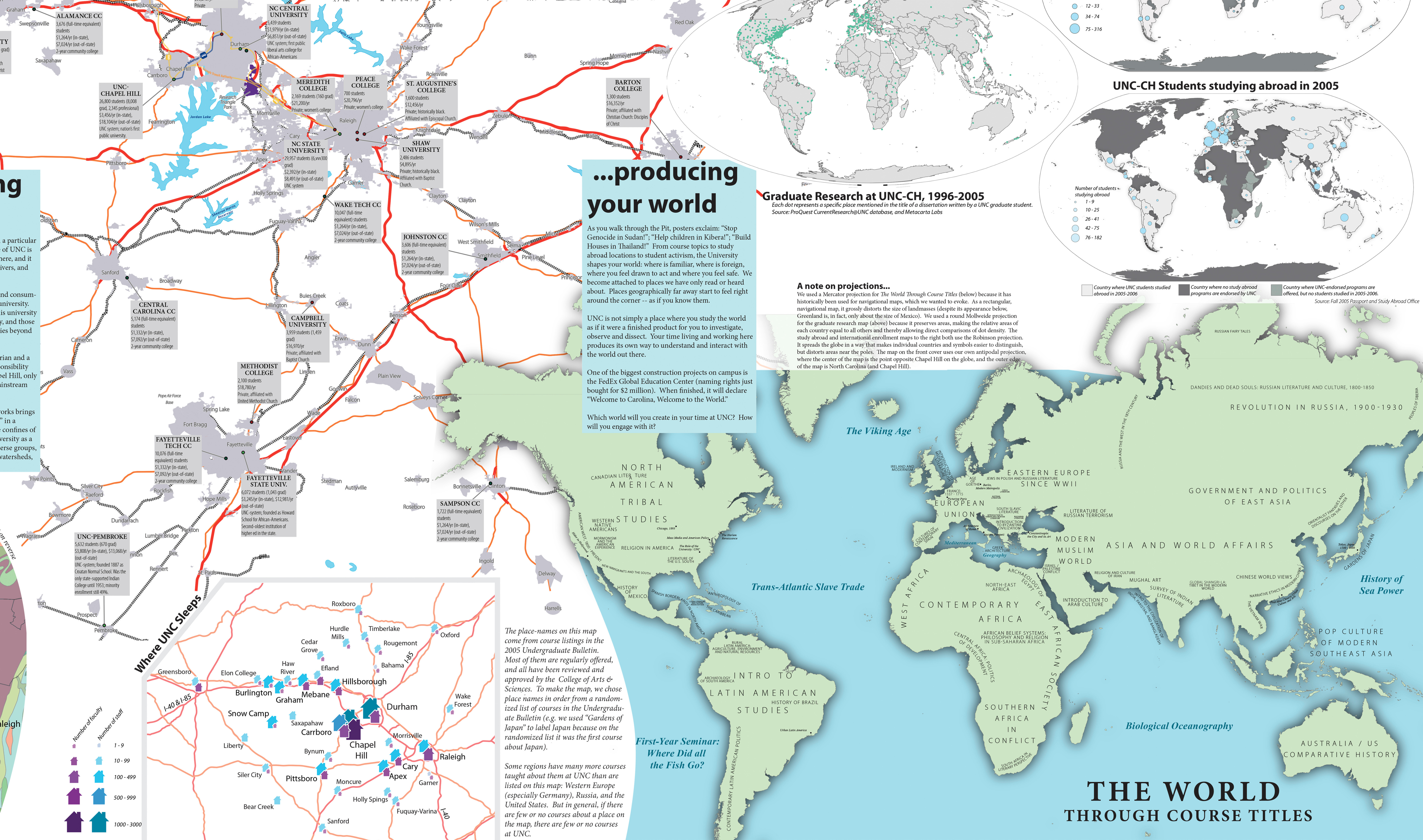
Our mapping collaboration blossomed into the best known 3Cs project to date, disOrientations: (y)our guide to UNC-Chapel Hill. The disOrientation Guide multiplies understandings of the University of North Carolina at Chapel Hill to complicate notions of the university as an aloof ivory tower, detached from the socalled real world. We mapped UNC-Chapel Hill as a multiplicity of processes with many entrances and exits, thoroughly integrated with local and global economies of knowledge production.
The visual chaos on first viewing is an intentional attempt to explode any simple, singular or territorial notion of the university. A close look reveals a framework, but even that is not discrete. The margins of each theme conceptually and graphically merge into others. Three general concepts, corresponding to different theoretical perspectives, organize the front of the guide. The reverse side serves as a response to re-orient the viewer.
UNC is a factory. Guided by a Marxist analysis, this concept plots the university within regional and global relations of knowledge production and labor. Maps show the dense network of higher education and corporate knowledge production in which UNCCH is located. Corporations at the Research Triangle Park profit from the results of publically funded and cooperatively produced knowledge in the university, as well as the labor of university workers. This regional economic growth regime shapes the university. Students not only learn the course material, but also to be researchers, programmers, inventors, and entrepreneurs, becoming accustomed to precarious living and working conditions in order to fuel the creative economy (Moten & Harney, 2004).
UNC is a functioning body. Guided by Deleuzian ideas, this concept highlights how the university is materially embodied. Knowledge production and immaterial labor cannot be composed purely of abstraction. The university is composed of people that eat, sleep, travel, use natural resources, and profoundly affect the environment they inhabit. The maps in this section investigate the practices and networks that literally make up the university. Maps include where faculty and staff sleep (live) and how spaces, such as tiny pedestrian areas and wide automotive roads, are defined in and around the university. Different appropriations of space affect how we envision and occupy the university.
UNC is producing your world. Guided by Foucault’s analysis of the productive interplay of power and knowledge, this portion maps UNC-CH’s role in the production of (geographic) subjects as global citizens in a particular discourse about the world (Foucault, 1995). Maps show where UNC-CH students study abroad, where foreign students come from, and what parts of the world are studied in undergraduate courses. From these maps, we see that UNC-CH is highly focused on the United States and Europe. Some places, such as popular study abroad destinations Sevilla and London, appear large in the university’s worldview, while others do not appear at all.
Reorientations. The reverse side of the disOrientation Guide further multiplies UNC-CH through a people’s history of the university and a directory of local progressive organizations. A local economies map draws on Gibson-Graham’s writings on local, diverse economies (1996, 2006). From cooperatively owned and managed bookstores and grocery stores to a really really free market where items and services are freely shared and exchanged, Chapel Hill is already awash with anti / non-capitalist practices. This side of the disOrientation Guide serves as a useful guide for newcomers to the area. It also illustrates that many other universities are not only possible, but are already being enacted.
Through these concepts, the disOrientation Guide brings together mapping and militant research in a visual, cartographic product. Nonetheless, this autonomous cartography is not completely encapsulated on paper: The importance of our work extends beyond the map to the process of making and sharing the map. Trust among friends created an open atmosphere for collaborative map-making and theoretical heavy-lifting. Not everyone entered the process with the same background or expertise, yet we avoided assigning permanent roles. In fact, the uneven distribution of expertise motivated us to socialize that knowledge, teaching each other skills and techniques throughout the process. For example, the one of us with basic cartographic training did not do all the graphic design but rather took the opportunity to share cartographic methods with other members of the collective. Such a collaborative process is often contentious and difficult to sustain. Positive, flexible attitudes, food (especially pizza) and regular breaks are imperative to keep the process moving forward.
At each meeting, members shared new map ideas, research, and cartographic design drafts. Early in this process, we decided on the general concept of the guide but not on the internal framework. Through our continuing conversations and mapping, our theoretical analysis and practical understanding of the university began to emerge. The framework of the guide came together in a single marathon meeting that set up the three-concept front side. Initially distributed in undergraduate and graduate classes, the guide prompted interesting discussions about students’ labor, faculty salaries and the university’s relations with other social and economic institutions.
We were surprised to find that the disOrientation Guide also had value for other activist groups, even those outside Chapel Hill. The relevance beyond UNC-CH allows for greater conversations and collaboration through mapping with other groups. These are processes of sharing and creating knowledge, forming relationships and producing new subjectivities. We continue to distribute disOrientation Guides for free through student and activist networks and our website.
While distributing the first guide, 3Cs continued to conduct research and map knowledge production. Out of this work, we produced other graphic products, including a comic book about UNCCH’s drive to build a research campus, a zine about budget cuts and, in 2009, a second disOrientation Guide.3 disOrientations2 focuses on UNC-CH within the mutually related crises of the university and the economy, delving more deeply into the ways precarity, migration and global resistance struggles were playing out on university campuses at the time.
Much like the first disOrientation Guide, the idea of disOrientations2 is to explode the notion that our university and others have a simple, singular problem, a budget shortfall. disOrientations2 includes maps and graphics of the game of university rankings, the role of migrants in knowledge production, the precarious
labor conditions of many university employees and struggles for alternative higher education around the world. Following the first guide, disOrientations2 plots multiple processes and existing equitable alternatives to current university struggles. Compared to the first guide, it has a stronger focus on subjectivity and how we were individually and collectively navigating the crevasses of the university in crisis.
With several international participants in the collective, an important analytical element in disOrientations2 is the question of mapping how UNC-CH is part of the broader border regime. We map how the university functions as a border with a flow-chart of rules, restrictions and regulations related to student visas, as well as with a map of student migration flows. We also map how the university produces precarity, documenting the uneven implementation of austerity measures. We map the effects of rankings and competition, as well as a global wave of protest at university campuses that inspired our efforts. The second disOrientations Guide is also an explicit attempt to generate new networks and alliances with struggles in different places as part of our political project. Some of the data for the guide was even crowd-sourced via those same networks.
As our maps and practices of counter-mapping and militant research traveled, a few of us also traveled to London to participate in a project counter-mapping Queen Mary University.4 A set of international students with different theoretical backgrounds, personal experiences, skill sets and familiarity with mapping, coalesced around this project. The resulting map served as a direct intervention in a specific political moment, bringing together the issues of migration and student struggles, both important political issues at the time, but lacking dialogue between activists dedicated to each issue.
The front side maps the flows of international students into the UK, depicting the political economy of migration as well as the hierarchical relationships created in a university increasingly defined by rankings and the “research excellence framework.” Filters depict the borders, showing that the border lets some people in while keeping others out, transforming everyone in the process. The map also shows sites of resistance, giving symbolic visibility to the burgeoning student movement. The other side attempts to delve deeper into the subjective aspects of migration through a board game that allows players to experience the journey of students from different origins studying in London. The game was designed after interviews and conversations with international students, inside the collective and out, allowing us to incorporate their experiences – both their suffering and constant forms of resistance – into the game and creating stronger relationships between those students in the process.
Making the map, each participant contributed according to their skills: drawing icons or sea monsters, using mapping or design software, researching migration laws and data, building a theoretical framework. Yet we also learned from one another, taking care to socialize those skills and know-hows. As part of the research process, we organized a public seminar called “What is the university?” and a mapping workshop as well as a collective re-search drift through campus. These events and actions helped us to expand the mapping process beyond the collective to include the larger university and activist communities.
Our experiences with autonomous cartography illustrate how mapping can function as a form of militant research, producing novel knowledges and subjectivities while also investigating and instigating political change. For 3Cs, this means not only producing empowering maps but also creating alternative forms of social organization within and beyond the collective. These experiences highlight the importance of collaboration and trust as well as careful consideration of the social context and ethics of mapping. This work is premised on the idea that geographic knowledge and spatial creativity are produced by movements and people affected by different forms of dispossession and ready for dissent.
Around the world, spaces of resistance and autonomous knowledge production are emerging as the rhetoric of crisis and budget cuts are being used to further privatize universities and enclose knowledge. In this context, 3Cs is changing: We are now geographically diffuse, positioned in different sites of the social factory and on different schedules. This forces us to rethink the locally-situated nature of our research and insist on devising horizontal methods of collaboration across space, availability and different precarious arrangements. In new situations and challenges, 3Cs continues to explore the political possibilities of and, and, and…
Casas-Cortés, M. & Cobarrubias, S. 2007. Drifting Through the Knowledge Machine. Shukaitis, S. & Graeber, D., eds. Constituent Imagination: Militant Investigations // Collective Theorization. Oakland: AK Press: 112-126. countercartographies.org/download/drifting_through_the_knowledge_machine.pdf, 14 January 2018.
Counter-Cartographies Collective 2009. Practices of Radical Cartography. In The Edu-factory Collective, ed. Toward a Global Autonomous University. New York: Autonomedia: 110-113.
Counter Cartographies Collective, Dalton, C. & Mason-Deese, L. 2012. Counter (Mapping) Actions: Mapping as Militant Research. ACME: An International Journal for Critical Geographies, 11(3): 439-466.
Stallmann,T. 2012. Alternative Cartographies Building Collective Power. PhD Thesis.The University of North Carolina at Chapel Hill. countercartographies.org/download/stallmann-ma_thesis.pdf, 14 January 2018.
Borio, G., Pozzi, F. & Roggero, G. 2007. Conricerca as Political Action. In Coté, M., Day, R. & Peuter, G., eds. Utopian Pedagogy: Radical Experiments Against Neoliberal Globalization.Toronto: University of Toronto Press: 163-185.
Bousquet, M. 2008. How the University Works: Higher Education and the LowWage Nation. New York: New York University Press.
Gibson-Graham, J.K. 2006. A Postcapitalist Politics. Minneapolis, MN: University of Minnesota Press
Gibson-Graham, J.K. 1996. The End of Capitalism (as We Knew It): A Feminist Critique of Political Economy. Oxford: Blackwell Publishers.
Hardt, M. & Negri, A. 2000. Empire. Cambridge, Mass.: Harvard University Press.
Harris, L.M. & Hazen, H.D. 2005. Power of Maps: (Counter) Mapping for Conservation. ACME:An International Journal for Critical Geographies, 4(1): 99-130.
Holmes, B. 2003. Imaginary Maps, Global Solidarities. Piet Zwart Institute. automatist.org/photo/Pictures/pzi%202002-2006/2003-04-brian_ holmes/Piet%20Zwar t%20Institute%20-%20Imaginar y%20Maps,%20 Global%20Solidarities.html, 1 July 2018.
Holmes, B. 2007. Disconnecting the Dots of the Research Triangle: Corporatisation, Flexibilisation and Militarisation in the Creative Industries. brianholmes.wordpress.com/2007/02/26/disconnecting-the-dots-of-the-research-triangle, 14 January 2018.
Lazzarato, M. 1996. Immaterial Labor. In Virno, P. & Hardt, M., eds. Radical Thought in Italy: A Potential Politics: 133-47.
Malo, M. 2007. Nociones Comunes. Experiencias y Ensayos entre Investigación y Militancia. Madrid:Traficantes de Sueños.
Moten, F. & Harney, S. 2004.The University and the Undercommons: Seven Theses. Social Text, 22(2): 101-115.
Peluso, N.L. 1995. Whose Woods Are These? Counter-Mapping Forest Territories in Kalimantan, Indonesia. Antipode, 27(4): 383-406.
Pickles, J. 2003. A History of Spaces: Cartographic Reason, Mapping, and the Geo-Coded World. London ; New York: Routledge.
Precarias a la Derive 2006. A Very Careful Strike: Four Hypotheses. The Commoner, 11: 33-45.
Bunge, W. 1971. Fitzgerald: Geography of a Revolution. Morristown, NJ: General Learning Press. jstor.org/stable/j.ctt46nbwg, 14 January 2018.
Cobarrubias, S. 2009. Mapping Machines: Activist Cartographies of the Border and Labor Lands of Europe.The University of North Carolina at Chapel Hill. countercartographies.org/download/cobarrubiasdiss.pdf, 14 January 2018.
Cobarrubias, S. & Pickles, J. 2008. Spacing Movements:The Turn to Cartographies and Mapping Practices in Contemporary Social Movements. The Spatial Turn. Interdisciplinary Perspectives. New York: Routledge: 36-58.
Colectivo Situaciones 2007. Something More on Research Militancy: Footnotes on Procedures and (in) Decisions. In Shukaitis, S. & Graeber, D., eds. Constituent Imagination: Militant Investigations //Collective Theorization. Oakland: AK Press: 73-93.
Colectivo Situaciones & de Solano, M.T.D. 2002. La Hipótesis 891. Más Allá de los Piquetes. First edition. Buenos Aires: Ediciones de Mano en Manoo.
Crampton, J.W. 2010. Mapping: A Critical Introduction to Cartography and GIS. First edition. New York: Wiley-Blackwell.
Deleuze, G. 1988. Foucault. First edition. Minneapolis: University of Minnesota Press.
Deleuze, G. & Guattari, F. 1987. A Thousand Plateaus: Capitalism and Schizophrenia. Minneapolis, MN:The University of Minnesota Press.
Edu Factory Collective 2008. Universita Globale: il Nuovo Mercato del Sapere. Rome: Manifestolibri.
Foucault,M.1995.Discipline and Punish:The Birth of the Prison.SecondVintage Books edition. New York, NY:Vintage Books.
Frassanito Network 2005. Precarious, Precarisation, Precariat? Mute, 2(0): 60-62.
An earlier version of this text appeared as Dalton, Craig and Liz Mason-Deese. 2012. Counter (Mapping) Actions: Mapping as Militant Research. ACME: An International E-Journal for Critical Geographies 11(3): 439-66.




 Except where otherwise noted, content on this site is licensed under a Creative Commons Attribution 4.0 International license