Mapping Postkolonial
An Archive of Post/Colonial Traces, Layers and Spectres in Munich
mapping.postkolonial.net
The map is a cooperation of [muc] münchen postkolonial, Zurich-based Art Project Labor k3000 and the Munich-based Ecumenical Office for Peace and Justice e.V.. The project was funded by the Foundation Remembrance, Responsibility and Future (Stiftung EVZ).
We are a team of researchers, activists, artists and programmers/software engineers. Our academic backgrounds are somewhere between the arts, sociology, anthropology, political science and history. Some of us have worked on critical mapping before; some of us are part of the group [muc] münchen postkolonial that has done activist research on post/colonial traces in Munich and has been involved in different decolonizing projects and actions since 2006. Many of these experiences and much of this knowledge have found their way into our postcolonial map of Munich.
Decolonizing Munich
Unlike cities such as Hamburg – with its access to the sea – and Berlin – as the capital of imperial Germany – Munich was not a hub of colonial activity. Nevertheless, colonialism is also deeply ingrained in Munich’s civic society, having shaped it on a sustained basis through the ages. The numerous remnants and traces of colonialism that can be found to this day inside Munich testify to the history and continuing presence of post/colonial realities. At the same time there are a number of traces and places whose colonial associations are no longer, or only very obliquely, evident today. Despite being unseen and unspoken, these frequently tell us more about our present dealings with the colonial past than the supposedly obvious ones. Tracing their history, inquiring into the historical contexts of their rises and declines, and articulating the frequently unspoken forces they represent will change the way we see the city. mapping.postkolonial.net presents a snapshot of this investigation, which does not seek to present Munich as having had a special role in colonialism. The aim is rather to expose the seemingly commonplace banalities of colonialist world views and post-colonial conditions for contemplation and debate – in their full diffusion and impact. Exposing and reflecting on these is both a precondition for, and a part of, the process of decolonialization. The project maps post/colonial vestiges in Munich. Some of these are still visible in the city, some require an intent view, many stay invisible: the statue of a colonial sculptor, the fading marks of a colonial memorial plaque on a cemetery wall, a renamed street, a non-existent grave. The obvious and hidden vestiges in the city function as a vision panel to get a closer look and question the present and past of post/colonial relations.
How to Use It
There are three different approaches to use the website mapping. postkolonial.net.
Mapping
The interactive map of Munich shows numerous traces of the city’s colonial past. By clicking on some of the crosses, the history of the traces, narratives and theoretical layers are revealed.
Trip for Traces
If you like to do your own reasearch in the city, there are several thematic tours recommended. A version for mobile devices navigates you through the tours. For further information visit the website mapping.postkolonial.net/m.
Archive
All traces, narratives and theoretical layers are listed in the archive. There you will also find additional material, sources and the exact location marked on a city map.
Search for Traces
Traces of the colonial past can be found all over the city. Traces can for instance be places, sculptures, tombs, commemorative plaques, museum exhibits and street names. They are linked with events, protagonists of the colonial history.
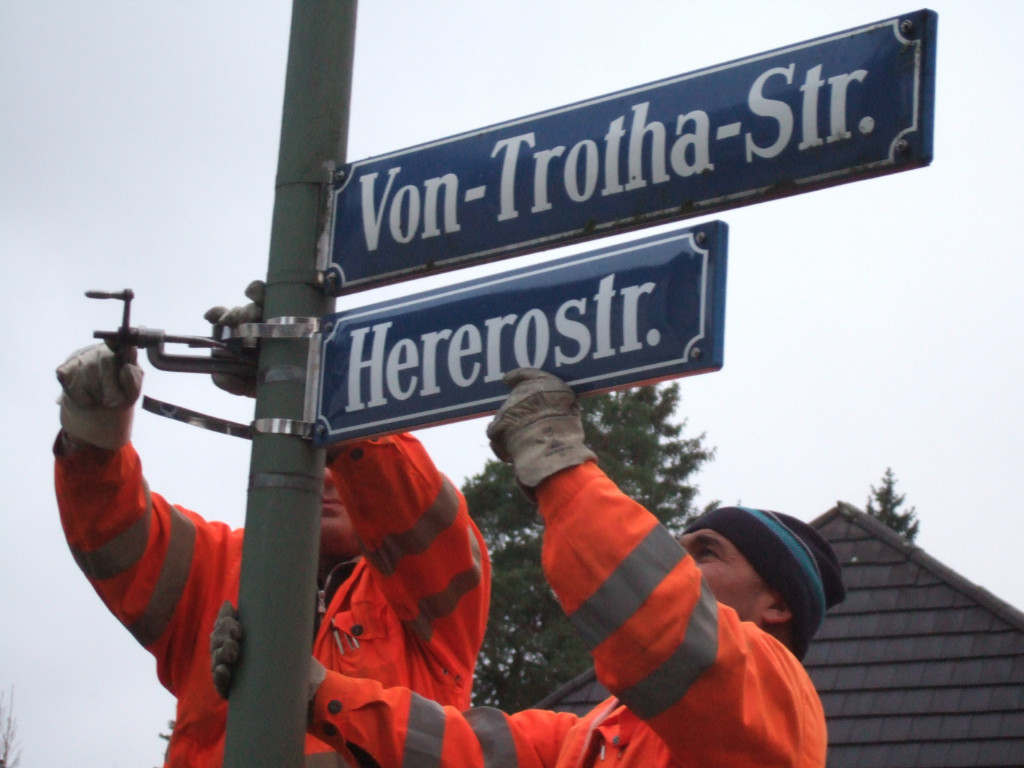
The Von-Trotha Street was renamed as Herero Street in the year 2007. The new street name commemorates the anti-colonial resistance of the Herero people against the authorities in the German colony South-West Africa. The street is also dedicated to the victims of the genocide (1904-1908) that followed the resistance activities. General Lothar von Trotha – the former name patron of the street – had commanded the annihilation campaign of the German “Protection Force”. There are still about 30 streets in Munich that are named with a clear positive reference to colonial actors, places and events. The Munich Foreigners’ Advisory Council and other groups have repeatedly demanded the renaming of these colonial streets.
Narratives
The Narratives are telling the common story of different vestiges of Munich’s colonial history. Referring to historical events, the narratives relate the impact and agency of the protagonists of colonial history.
A plaque was installed at the New Town Hall in 1913 to commemorate German soldiers who had been killed in the colonies. During renovations in the 1960s the plaque was damaged and taken down. A new commemorative plaque was installed at the Old Southern Cemetery. After having been paint-bombed and sprayed repeatedly, it was first fixed at a higher level and then removed. After another restoration the plaque was re-installed at a more visible and controllable place outside the cemetery (see photographs in galery).
Spectres of Colonialism
Colonialism is dead yet it still lives on. As a shadow of the colonial past, it continues to haunt people and societies, even though this is barely noticeable at times: in colonial furniture, in the colonial style featured by delicatessens and restaurants, revived in commercials, films and documentaries, and in clinging to colonial monuments, street names and racist appellations and epithets. Time and again attempts to exorcize these specters in disputes about street names or racist terms in children’s books demonstrate how flexible, protean and yet persistent they are. Colonialism is dead and yet it still spreads calamity.
At a shooting gallery at the Munich Oktoberfest in the year 2014, visitors could shoot at two targets that were racist representations of black people. As an answer to critical reactions the municipal administration installed an information board, that claimed that the men pictured as targets in the shooting gallery were wearing “typical German clothes with a top hat, respectively a spike helmet”. This – the information board explained – should be read as a reference to the German colonies in Africa. Overlooking that colonialism was a genuinely racist project, it went on: “The targets thereby neither have a racist background nor a racist motif. They’re to be interpreted exclusively in the historic colonial context.”
Layers
The Layers offer different approaches to theoretical discourses about colonialism and racism.
Colonialism was not a unique event, not a clearly defined era, not a geographically limited phenomenon. Colonialism was and is a global system of domination by a power that culminates in the subjection and exploitation of others. It is a phenomenon deeply ingrained in both the colonizing and colonized societies – in social, political and economic relations, in laws, decrees and administrative processes, in architecture and monuments, in our mindsets and our actions. This colonialization renews itself constantly so that it has survived until today. At the same time, it is being superseded and subverted by decolonizing processes and practices. Decolonizing means uncovering the remnants and traces of colonialism in minds and societies. Decolonizing means liberating and reconceptualizing, i.e. actively discarding the colonial and racist world views, modes of thinking, practices and privileges that we have adopted both consciously and unconsciously. Decolonization is therefore at once a process and the goal of that process.
Gallery