This is not an atlas

An atlas of countercartography

  • Maps
  • Book
  • News
  • Videos
  • About
  • EN
Hide Search

Teaching counter-cartographies #3

Acting in- and out-side the classroom: collective mapping for an engaged teaching

  • + info
    • Mariasole Pepa and Francesca Acetino (University of Padova), Diletta Damiano (ISIA Roma Design), Paul Schweizer and Tuline Gülgönen from kollektiv orangotango, and Local development students
       

Gallery

Pdf
click on the map
Click to zoom the map
CategoryEducation TopicColonial ContinuitiesCritical ResearchGenderScholar Activism RegionItalyPadova

In November and December of 2023, we led a three weeks workshop-cycle on collective critical mapping at the University of Padova, in the frame of the Course Geographical Space: Concepts, tools and practices of the Master’s Degree in Local Development, with international students coming from various parts of the world, with different personal and academic backgrounds.
The idea of making a critical mapping workshop an integral part of a Master’s course was shaped by the urgency to introduce students to participatory tools and, what’s more, to invite them to a critical and activist approach to social research. In this sense, applying concrete projects of collective critical mapping on relevant topics, and in dialogue with local activist groups appeared as an appropriate way  to rethink ways of doing and thinking “development”. Furthermore, we hoped to open discussions on dominant ways of imagining the world and make the map an instrument to visualize underrepresented voices and experiences, to expose injustices and promote progressive struggles.
Yet, the idea of a practical mapping activity within the course’s framework was also related to the feedback from the previous year’s students – regarding the importance of learning to think critically, on the one hand,  and expressing a feeling of powerlessness to act in the face of global injustice, on the other (Caretta & Pepa, 2023). So, the urgency was, indeed, to create a space to think through a pedagogy, and geography, of hope (Lopez, 2023) – to make the classroom a radical space of possibility to put it in bell hooks’ (1994) most inspiring words.
Thus, in mid-2023, we – Mariasole, Francesca, and Diletta – contacted kollektiv orangotango, with the request of facilitating a practical counter-mapping experience. Joined by Tuline and Paul, we indulged in extensive debates about the (im)possibilities and potentials of such an endeavor. At the core of our discussions was a central learning from kollektiv orangotango’s practice as counter-cartography facilitators.
In order to do justice to the transformative claim inherent in the “critical” of “critical cartography”  – if we take it seriously – we must address real problems, and produce relevant maps. This leads us to the problem: How can we avoid succumbing to the “mapping for mapping’s sake” so common in the context of the current “mapping hype” (Schweizer & Halder 2024) and yet, within the limited framework of a university cycle of  seminar, enable a practical mapping experience?
Our – kollektiv orangotango’s – categorical answer to this is: Listen to the movements! That is to say, bring students in contact with local militants, in order to find the ways in which mapping can, indeed, become a tool for progressive struggles in a given context. So, before the beginning of the semester, we got in contact with local activist groups, to understand whether they would see a use for mapping within their field of activity. Yet, this led us to even further questioning: How to facilitate direct contact between students and social movements, promoting, indeed, academic support of activists’ work, instead of, as happens so often, binding activists’ precious time and knowledge in yet another unpaid activity on university grounds? Is this kind of engagement possible within the restricted framework of a two-hours weekly academic seminar, at all?
The workshop-cycle consisted of an introductory session, followed by two sessions in which the students initiated their collective mapping, and a session of restitution. The students organized themselves to continue the mapping between the sessions. As the time frame of the workshop did not permit an extensive process of field work but also because of the importance of a situated point of view, we asked student groups to map the respective topics from a rather personal point of view, and to use their own experience as the main source of data. Yet, the topics selected – housing condition, decolonial traces, and gender/care – resonate with Padova local struggles. To avoid the trap of appropriating activist energies for academy, rather than vice versa, we decided not to engage activists in the class, but to invite them to the final presentation of the maps, so they could see if these were of any use for struggles and imagine future collaboration.

Mapping process

Following a Freirean approach of “problem-posing education” (Freire, 2000 [1970], 79), we intended to propose topics that would, both, reflect their own everyday-life experiences and problems as newly arrived international students in Padova; and, at the same time, practically connect them with existing local militant groups and social movements. After long discussions and based on our experiences with previous cohorts, three topics were selected that also correspond to three local activist group with whom we were in contact: housing conditions, as in the last years increasingly became a central issue for students in Padova; gender/care issues, understood in a broad sense as the relationships between their gender/orientation and spaces; and colonial/decolonial traces in Padova.
The maps were elaborated in four groups. Throughout the process, students reflected on the methodologies, on the selection and collection of information, the design choices, and the relationship between academia and local collectives based in Padova. We’ll present the maps here, accompanied by reflections from the student groups themselves.

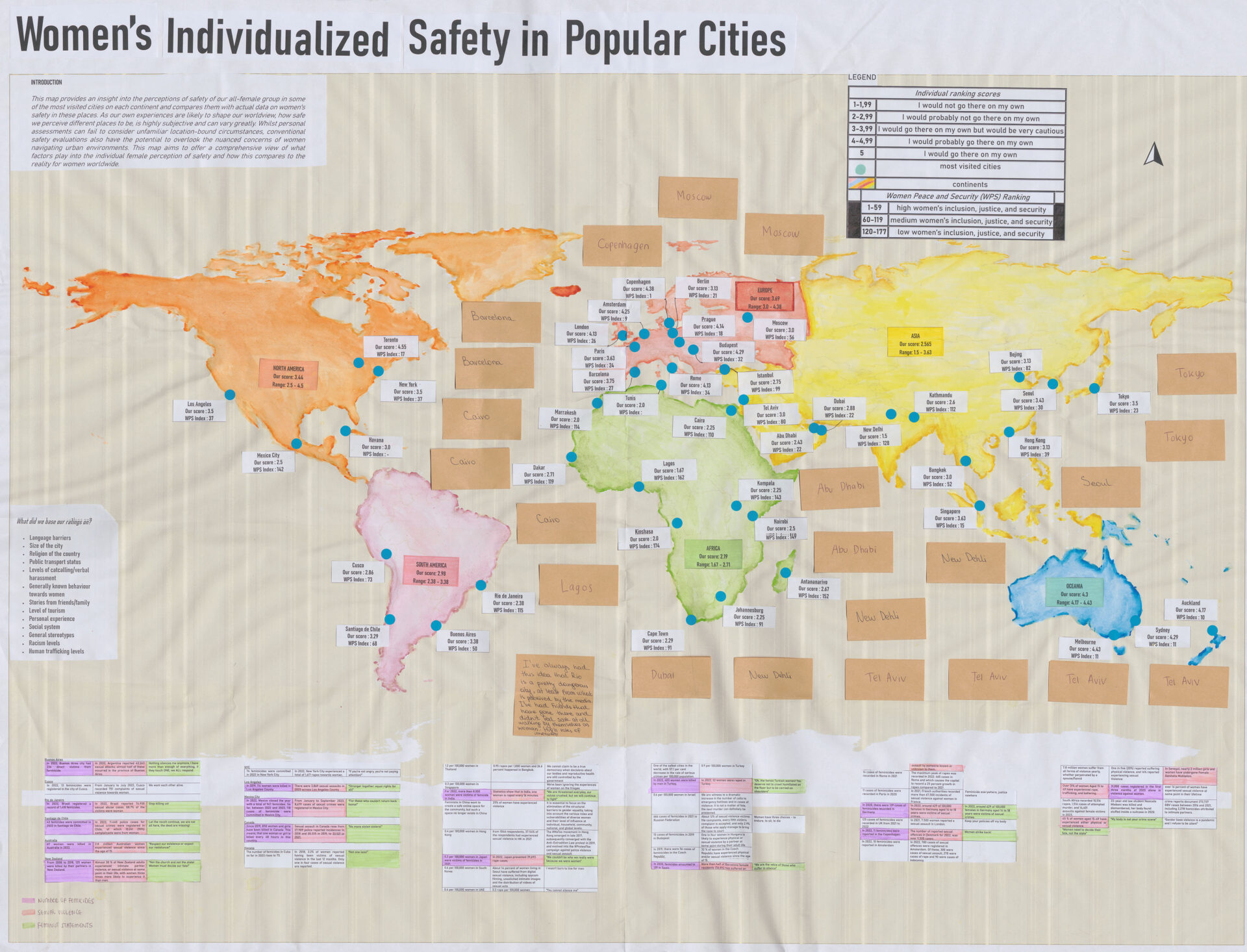
Women’s individualized safety in popular cities

“Our map reflects perceptions of women’s safety in major tourist cities, comparing them with safety indicators”. As a group of women from 22 to 28-years-old from various countries, these students conducted a study to understand the relationship between their perception’s and challenge the classification of cities as safe or unsafe based on existing statistics. “The mapping process is a personal journey reflecting the unique perspectives of young women. The map serves as a creative instrument to exchange diverse ideas”.

Padova through “your” eyes

“We decided to investigate and map gender-based violence (GBV) cases in Padova, basing our study firstly on our own experiences and then talking to other students of the University of Padova”. This group focused on gender-based perceptions of insecurity and different conceptions of “safety” through the lens of intersectionality. The map is based on the assumption that the visualization of places where GBV has occurred leads to the understanding that there are no safe and unsafe places per se, and that “there is no such thing as absolute safety in the city”.

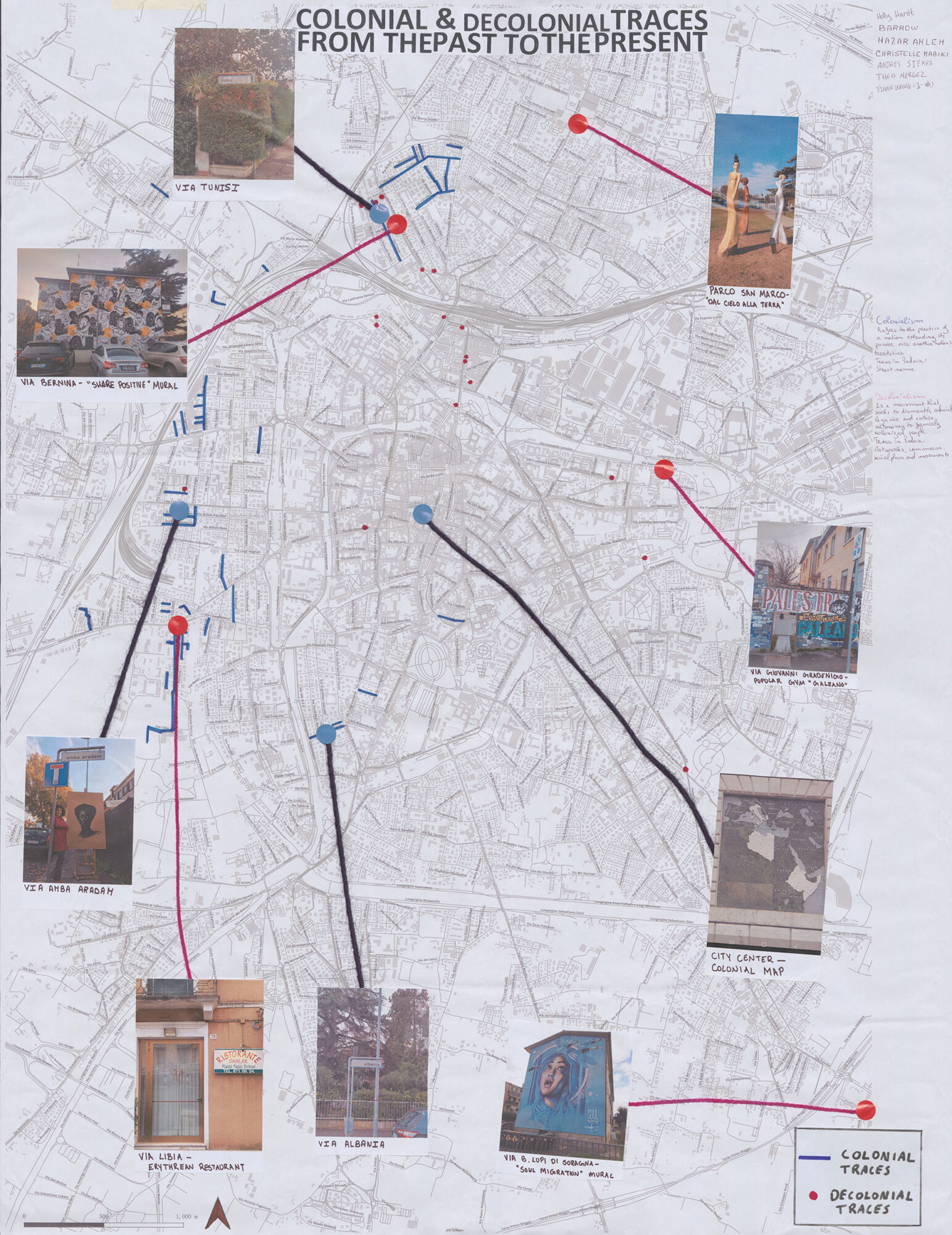
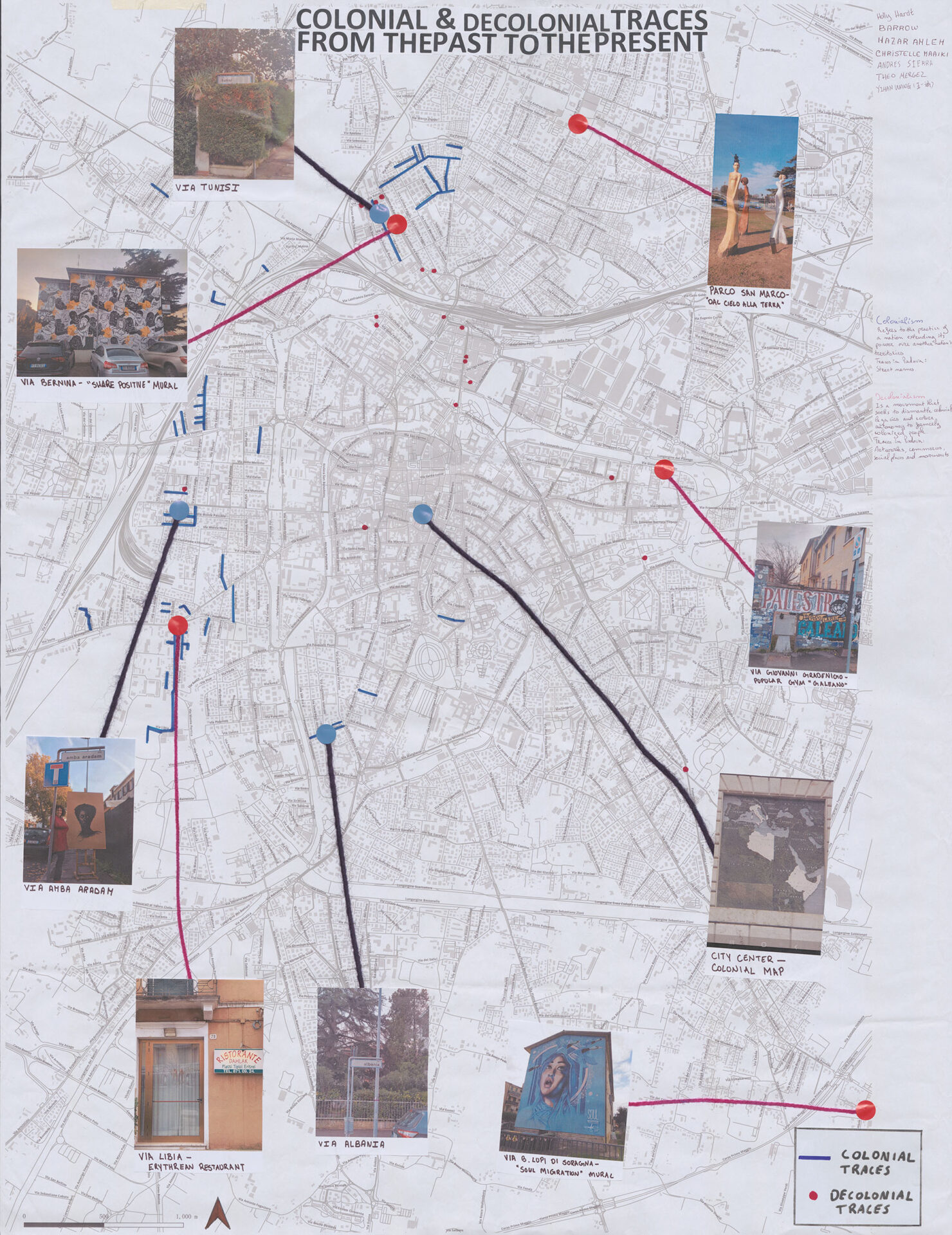
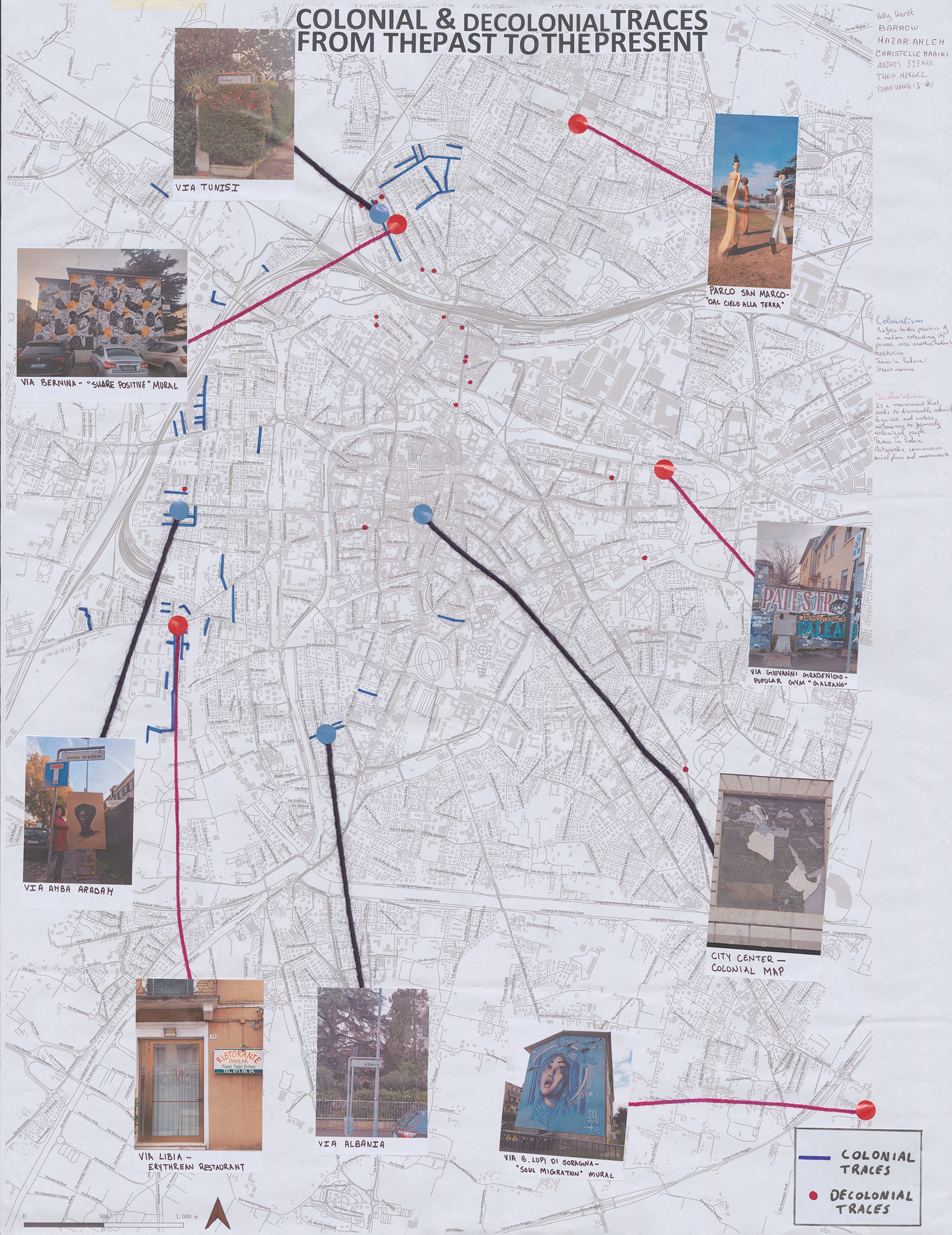
Colonial and decolonial traces from the past to the present

“As a group of international students at the University of Padova – none of whom are Italian – we were interested in exploring the colonial traces in our new home”. This group examined the past and present of colonial and decolonial traces, through street names, shops, and monuments, in different neighborhoods of Padova. “Our map shows how individuals and communities can move forward by reinventing the places that glorify colonization”.

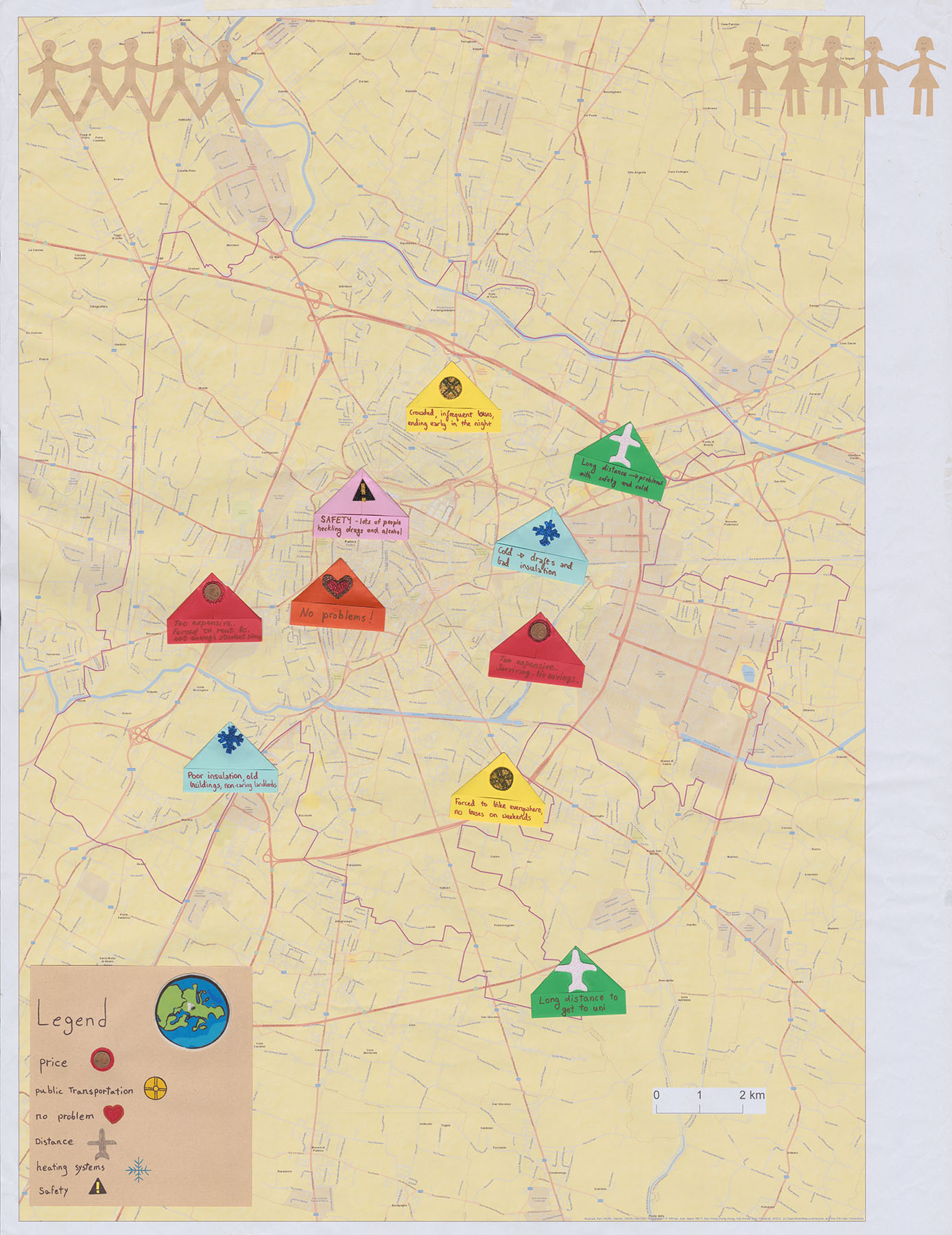
Housing condition in Padova

“The housing issue [in Padova] is a very delicate matter… factors like the high prices for the rent and the deposit; the far away locations; the rude landlords; the problems with the utilities, specially with the heating malfunctioning and overall the availability of rooms, apartments and and space in the [University] residences are the main situations we could identify and that are now presented on the map”. The group that worked on this map wanted to create an informative tool to represent some of the difficulties faced by Local Development students in finding a house in Padova.

Reflections – map as a tool

“[The map] is an instrument to exchange ideas and feelings. Valuing cultural diversity and representing territory as a continuous, relational space. Involves creative brainstorming, manual work, and subjective perspectives” (feedback from students).
“This thing [mapping] can have wider implications that we can only imagine now” (Marco from Catai)
The students considered their maps as a tool, as a starting point for future developments, as a means of visualizing and formalizing problems and issues that usually remain marginal in mainstream debates. While emphasizing the short time allotted to the mapping process, they saw it  as a “personal journey”, wherein maps were perceived as a way to show “how individuals and communities can move forward by reinventing places”, with an active and transformative intention on reality. The map emerges as a medium for connecting theory to social, economic and geographical space.
Yet, after the course ended we interviewed members of the collectives engaged in the final maps restitution  – Catai, Non una di Meno Padova, and Decolonize your Eyes – to learn from their perspective on maps as tool, and on ways to facilitate collaboration between teaching/the classroom and local activist group. Indeed, our aim is to reflect on how knowledge produced within an academic course can surpass classroom boundaries to become a tool for action. Maps have been seen by the collectives as a useful tool to disseminate important issues and for its visualization.

A final remark …and a way to think forward

Classrooms at the University of Padova are designed for rather traditional teaching. This is reflected in the organization of the room: fixed desks and chairs. Rooms are not designed as spaces for creative teaching, for imagining collaborative and participatory activities. Trying to put alternative teaching into practice means not only dedicating energy and time in experimenting, but also clashing, both, symbolically and spatially and materially with an academia that, most often, fails to capture other ways of being in the class. This material reality instigates us even more to be out of class(rooms), both, in the physical and in the conceptual terms. After all, in order to teach – in a popular education stance, as coined by Freire (2000) and hooks (1994) “to teach” means to empower to apply – counter-cartographies, we need to listen to social  movements. Thus, we need to create spaces – and time (!), and care (!) – for activist-academic dialogue. Yet, this dialogue, in order to be trustful, critical and supportive, needs to be built on relations that exceed the classroom spaces and semester cycles. In this sense, it is our role as academics and facilitators to create these relationships, to hold accountability and be available for social movements’ demands even when the semester ends.
Imagining next year’s seminar and other teaching experiences within academic settings, we learn from interviews with collectives and reflect on the importance and the possibility of using their space and experience. We also discussed with the collectives whether they would be interested in being involved in the workshop next year. The collectives are interested about the idea of working together, and we are wondering how to weave this relationship: How to bring their knowledge and experience into the classroom? How to ensure that there is an exchange? How to make our means and resources available? And, finally, how to put our knowledge at the service of the local collectives?
These remain open questions with which we continue to engage, and hope to engage further with others interested in imagining ways of teaching counter cartographies.

…by Mariasole Pepa and Francesca Acetino (University of Padova), Diletta Damiano (ISIA Roma Design), Paul Schweizer and Tuline Gülgönen (kollektiv orangotango), and Local development students

Endnotes

“Local Development” is a two-year, international Master’s degree, taught in English at the University of Padova. The students did not participate in the final writing of this contribution but their reflections, feedback and ideas are presented in quotes along the text.

The course unit “Geographical Space: Concepts, tools and practices” held by Mariasole applies a critical approach to the concept of “development” and its coloniality opening to pluriversal ways of doing and being beyond western epistemologies (Murray & Daley, 2023).

References

Caretta, M. A., & Pepa, M. (2023). Decolonising pedagogy in practice: cuerpo-territorio to consolidate students´ learning. Journal of Geography in Higher Education, 1–9.
Freire, P. (2000). Pedagogy of the oppressed. New York: Continuum.
hooks, bell (1994). Teaching to Transgress: Education as the Practice of Freedom. New York: Routledge.
Lopez, P. J. (2023). For a pedagogy of hope: imagining worlds otherwise. Journal of Geography in Higher Education, 47(5), 792–804.
Murray, A.,  Daley, P. (2023) Learning Disobedience: Decolonizing development studies. London: Pluto Press.
Schweizer, P. & Halder, S. (2024). Don’t believe the mapping hype! Three steps back for an engaged cartography. In: Rossetto, T. & Lo Presti, L. (ed.) The Routledge Handbook of Cartographic Humanities. London: Routledge, 54-60.

Gallery

Related maps

  • Visualizing the Counter-Narratives of Port Said
  • The Materiality Language of Cartography
  • Information Overload
  • Counter-Mapping for Resistance and Solidarity in the Philippines
  • + info
    • Mariasole Pepa and Francesca Acetino (University of Padova), Diletta Damiano (ISIA Roma Design), Paul Schweizer and Tuline Gülgönen from kollektiv orangotango, and Local development students


Gallery

Pdf
click on the map
Click to zoom the map
CategoryEducation TopicColonial ContinuitiesCritical ResearchGenderScholar Activism RegionItalyPadova

Realized by

Find us on

Mastodon page

Facebook page

Instagram page

Vimoeo page


Newsletter

You can unsubscribe at any time and we’ll never sell, swap or share your details with anyone else. Read our privacy policy.

Check your inbox or spam folder to confirm your subscription.

Support

Also supported by

anstiftung | transformap | ASA FF

Legal

Except where otherwise noted, content on this site is licensed under a Creative Commons Attribution 4.0 International license

Impressum | privacy policy