How do we as critical cartographers share our knowledge and tools? How can we encourage students to become counter-mappers for their part and enrich counter-cartography their perspectives, skills and experiences? The series “Teaching counter-cartographies” explores these questions by presenting different teaching-learning experiences. It hopes to inspire, both, cartography lecturers, by offering heterodox approaches to teaching cartography, and experienced counter-cartographers, by sharing students invigorating, unorthodox cartographic works. The first contribution of the series comes from Weimar, Germany. Franziska Felger and Tillmann Gebauer report on the student-organised seminar ‘counter mapping masterplan’.
The course, self-organized by students in the context of and financially supported by the program ‘Bauhaus.Module’ at the Bauhaus-University Weimar sees itself as part of the longstanding efforts towards more participation in remodeling measures of the university campus. After a theoretical approach, taught in online lectures, we were able to reflect on our perspectives on the built environment. The goal was to document individual needs, ideas and wishes, as well as the everyday life on the campus. Furthermore, every participant should create a map in the broadest sense. So far, all the top-down planning processes for outdoor facilities, new buildings or conceptual master plans largely ignored individual perspectives and are therefore being questioned by the results of our course.
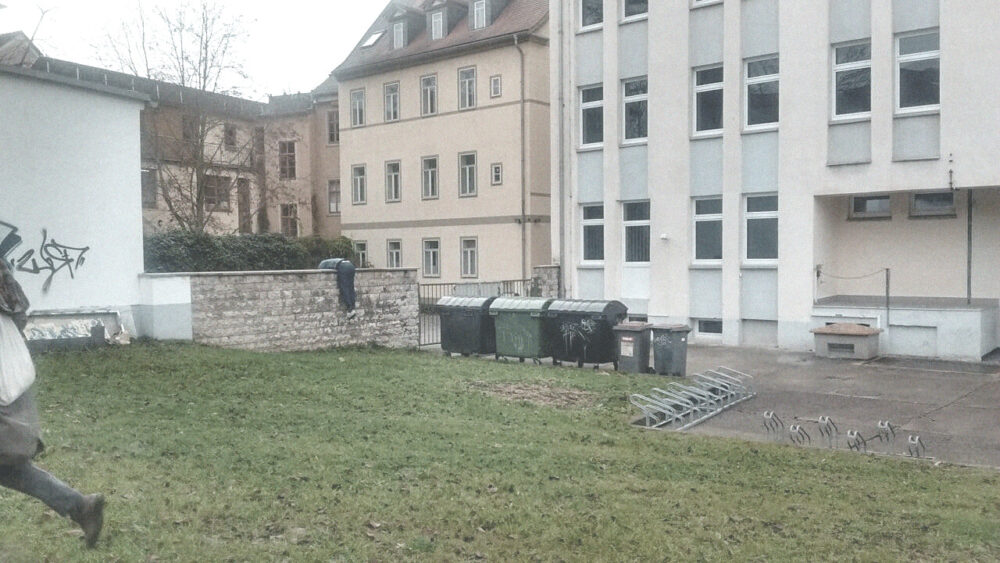
Who´s got the plan?
When master plans are seen as plans for the distant future, which ignore the spatial needs of the individuals in their processes, this catalogue can be seen as a counter-map (plan, design etc.). By definition, comprehensive and looking far ahead, master plans have difficulties to include the quickly changing needs, ideas and wishes of inhabitants and users. When planners never experience the spaces they are working with they need to implement an abstract meta-level that simplifies the otherwise not editable complicated spatial situation. This is to the contrary of the quickly changing, presence-bound and highly individual perspectives of the users on their plaza, street, or campus.
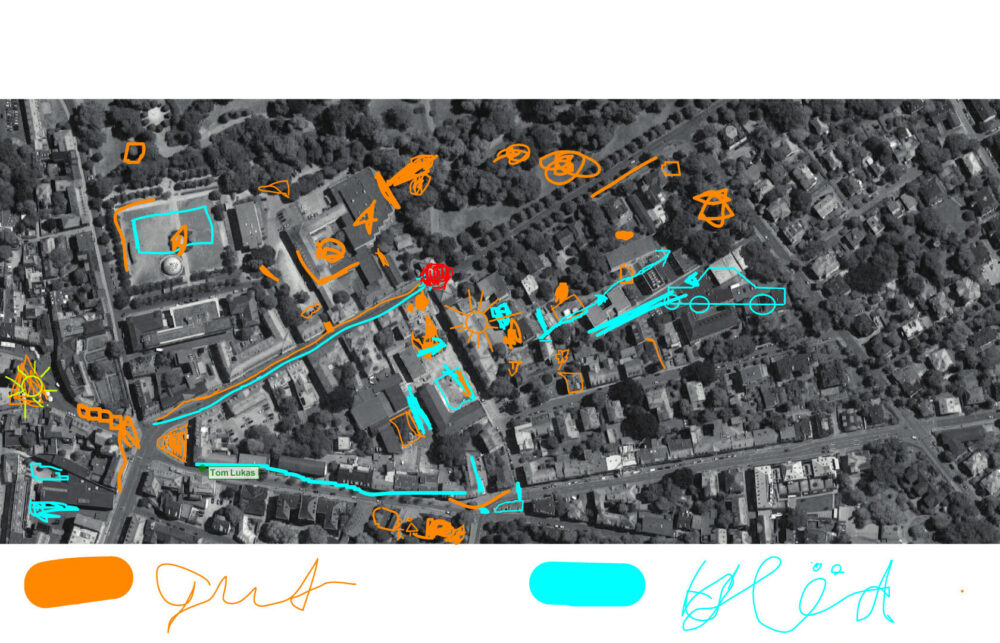
Nobody and everybody
That is why this course pleads for an open, flexible and incrementalist process and assumes that a university focusing mostly on planning and design can handle this freedom very well. However, counter-mapping must not be the only language when communicating about space. Especially at our university, we feel the need to open up a discussion about an experimental space. Moreover, we want to raise the question of who plans spaces and how can we design them together. As a participant puts it: “Make them maps, make them see, make them fight! Go on counter-mapping master plan!”
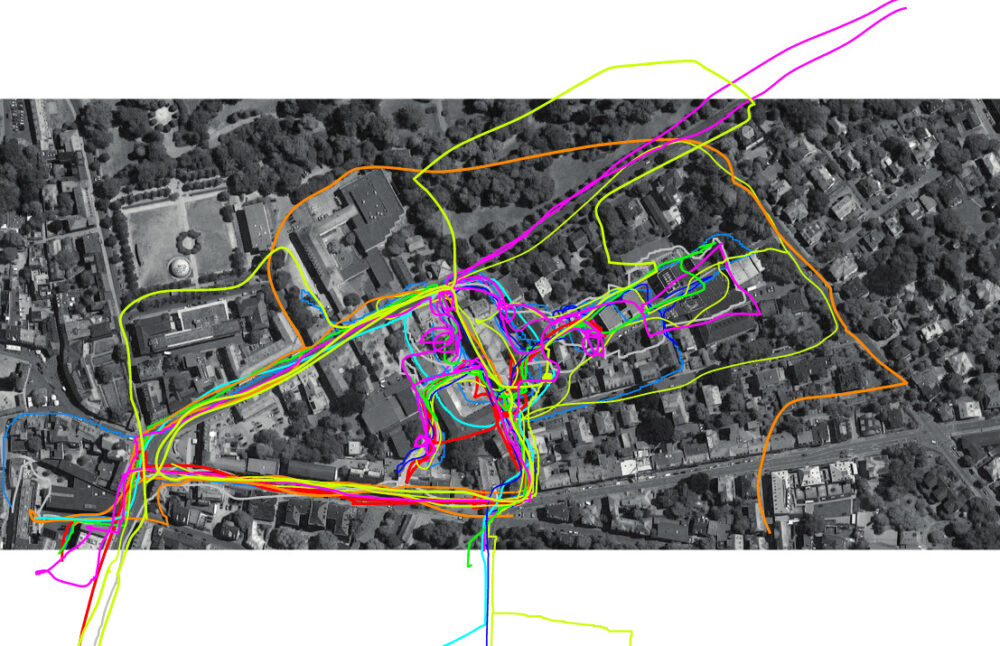
Lonely campus, lonely mapping
Some ideas, e.g. the temporary drawing of alternative uses onto the streets (1:1 mapping), were discarded due to bad weather. Others were not implemented due to the lack of time, or were impossible to carry out, because of the tightening of the pandemic regulations. Due to these extraordinary conditions, some of the counter-mappings’ outcomes are to be understood as snapshots from pandemic times. Even though it is not easy to summarize all perspectives, we could notice a clearly formulated longing for free spatial appropriation. We all miss a campus that gives us the space for self-actualization and a campus that can do more than only support the everyday life at university. Because one thing was displayed clearly: When the university closes its doors, the campus forgets its cause and loses its purpose. In reality it could be so much more. We should strive for an openly accessible urban space that functions as a joint between the university and the city. A space that serves as a canvas for the ever-changing ideas of the students and the people of the city.
The collected perspectives on and ideas for this highly contested space are now visible in the catalogue “counter mapping masterplan“. Unfortunately, it is only available in German language so far but at least the maps mostly speak for themselves. Have fun to put yourself into the points of view that are not your own.